Buy the size you will finish within 28 days of opening it. If you draw less than about 10 mL a month, a 10 mL vial wastes less and costs less overall. If you reliably use 20 mL or more from a single vial each month, a 30 mL vial is the better buy.
Vial size is the one decision people get wrong most often when buying bacteriostatic water, and it is usually because they compare the wrong number. The bigger vial almost always has the lower price per millilitre. It only saves money if you actually use those millilitres before the vial has to be thrown away.
The rule that decides it: 28 days from first puncture
Once the stopper of a multiple-dose vial has been punctured, USP <797> sets a limit of 28 days of use, unless the manufacturer’s labeling says otherwise. Bacteriostatic water is a multiple-dose product, so that clock applies to it. We explain where the rule comes from in how long bacteriostatic water lasts.
The key point for buying is simple: the 28-day window is the same for every size. A 30 mL vial does not get 84 days because it holds three times as much. Whatever is left at day 28 goes in the bin.
So the real question is not “which vial is cheaper per mL?” It is “how many mL will I draw out of one vial in 28 days?”
Quick answer by monthly use
| You use per 28 days | Better choice | Why |
|---|---|---|
| Under 10 mL | 10 mL vial | A 30 mL vial would end with two thirds or more thrown away. |
| About 10 mL | 10 mL vial | One vial, finished right around day 28, almost nothing wasted. |
| 10 to 20 mL | Two 10 mL vials, opened one after the other | The second vial stays sealed, and its clock does not start, until the first is empty. |
| 20 to 30 mL | 30 mL vial | You finish it inside the window, and fewer vials means fewer stoppers to open. |
| Over 30 mL | 30 mL vials, or several 10 mL vials | Either works. Pick on price per mL and how you like to work. |
The 10 to 20 mL row is where people overspend. It feels natural to buy one 30 mL vial “to be safe.” But two 10 mL vials used in sequence cover the same month, and if your use drops, the second one simply stays sealed until its expiration date instead of being opened and wasted.
A worked example
Say you draw about 8 mL of bacteriostatic water in a typical month. With a 10 mL vial, you open it, use 8 mL, and discard about 2 mL at day 28. With a 30 mL vial, you use the same 8 mL and discard about 22 mL.
Even if the 30 mL vial costs less per millilitre on the shelf, you paid for 30 mL and used 8. Our bacteriostatic water price guide runs this as a cost-per-usable-millilitre calculation with real numbers. For light users, the smaller vial usually wins by a wide margin.
Fewer punctures is a real advantage
Money is not the only reason to prefer a smaller vial. Every time a needle goes through the rubber stopper, it wears the stopper a little. Good technique reduces this (see how to draw from a multi-dose vial without coring the stopper), but it never makes it zero.
A 10 mL vial that you finish in, say, eight entries has seen far fewer punctures by the end than a 30 mL vial that is still half full after the same eight. If you draw small volumes, a smaller vial means each stopper does less work before it is retired.
Which sizes actually exist?
This surprises a lot of people. When we checked the bacteriostatic water listings on DailyMed, the National Library of Medicine’s database of FDA drug labels, every current product was supplied as a 30 mL vial. Hospira’s label, for example, lists two presentations:
- A multiple-dose 30 mL plastic fliptop vial with 0.9% (9 mg/mL) benzyl alcohol.
- A multiple-dose 20 mL fill in a 30 mL glass fliptop vial with 1.1% (11 mg/mL) benzyl alcohol.
That is why pharmacy and medical supply listings are dominated by 30 mL. The 10 mL vial is the common size from laboratory and research suppliers, and it is also the size you tend to see packed as a diluent alongside other lyophilized products.
Two practical notes follow from this:
- Check the benzyl alcohol percentage. Most bacteriostatic water is 0.9%, but the 1.1% presentation exists. If a protocol specifies 0.9%, confirm it on the label. Our guide to benzyl alcohol in bacteriostatic water explains the preservative.
- Check the fill, not just the vial. “20 mL fill in a 30 mL vial” means 20 mL of liquid. Compare listings by the millilitres of liquid inside.
When a 30 mL vial is the right call
None of this means large vials are a bad buy. A 30 mL vial makes sense when:
- You consistently use 20 mL or more within 28 days from one vial.
- Several people in the same lab draw from one vial, so it empties faster.
- You are working through a defined project with a known volume that fits inside one window.
If your use is steady and high, one 30 mL vial means fewer vials to open, date and track.
When 10 mL vials are the right call
- Your use is light or irregular.
- You want spare vials on hand without starting their clocks. Sealed vials keep until their printed expiration date.
- You would rather retire a stopper early than push it through dozens of entries.
- You are not sure how much you will need yet. Starting with 10 mL shows you your real monthly use before you commit to larger vials.
Stocking up without waste
The best of both approaches is to buy several small vials and open them one at a time. Only the vial in use is on the 28-day clock. The rest stay sealed and keep until their expiration date, as long as they are stored at room temperature and out of direct light. Our guide to heat, cold and shipping temperatures covers what “room temperature” means on the label.
Write the date on each vial the day you first puncture it. That one habit removes most of the guesswork about when a vial is due to be discarded.
The short version
- Choose the size you will finish within 28 days of opening.
- Under about 10 mL a month: 10 mL vials. Over about 20 mL a month from one vial: 30 mL.
- In between: two 10 mL vials opened in sequence beats one 30 mL vial.
- Compare listings by liquid fill and benzyl alcohol percentage, not just the vial size on the title.
Frequently asked questions
Is a 30 mL vial of bacteriostatic water better value than a 10 mL vial?
Only if you use most of it within 28 days of the first puncture. Anything left at day 28 is discarded, so a 30 mL vial you only draw 8 mL from costs far more per usable millilitre than a 10 mL vial.
How long does a 30 mL vial of bacteriostatic water last once opened?
The same as a 10 mL vial: up to 28 days from the first puncture, unless the manufacturer’s label gives a different period. Size does not change the in-use window.
Can I split a 30 mL vial into smaller containers?
It is not recommended. Transferring bacteriostatic water into other containers moves it out of its sealed, labeled multiple-dose vial and adds entries and handling that the 28-day limit does not account for.
Why do most pharmacy listings show 30 mL vials?
Current FDA-labeled bacteriostatic water products listed on DailyMed are supplied as 30 mL vials, including a 20 mL fill in a 30 mL glass vial. Smaller 10 mL vials are mostly sold by research and laboratory suppliers.
Does buying several 10 mL vials waste anything?
No, as long as they stay sealed. An unopened vial is good until its printed expiration date, so extra sealed vials simply wait on the shelf. Only an opened vial starts the 28-day clock.
How many times can a vial be punctured?
There is no single number, but every puncture wears the stopper. A smaller vial finishes in fewer entries, which is one practical reason people who draw small volumes often prefer 10 mL.
Sources
- DailyMed: Bacteriostatic Water for Injection, USP (Hospira) prescribing information dailymed.nlm.nih.gov
- DailyMed: Bacteriostatic Water for Injection, USP label dailymed.nlm.nih.gov
- USP General Chapter <797> Pharmaceutical Compounding: Sterile Preparations usp.org
- ASHP: Crosswalk of guidance and standards for managing beyond-use dates ashp.org
We write from primary sources such as FDA drug labels and USP standards. See our editorial policy. Spot an error? Email [email protected].
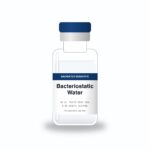
From BacWater Scientific
10 mL bacteriostatic water, stocked in the US
0.9% benzyl alcohol, multi-dose vials. The per-vial price drops automatically at 3, 5 and 10 vials.