Check three things on a bacteriostatic water label before anything else: that it says bacteriostatic with a benzyl alcohol percentage (usually 0.9%), that it says multiple-dose, and that the expiration date has not passed. Everything else on the label either identifies the vial or tells you how to store it.
Vial labels are small, and bacteriostatic water labels pack in a lot. The good news is that the same dozen or so items appear on nearly every vial, in a fairly predictable layout. Once you know what each one means, reading a new vial takes about ten seconds.
A typical label, line by line
Here is the text from the vial label of an FDA-labeled 30 mL bacteriostatic water product, as published on DailyMed. Layouts vary between manufacturers, but the content is much the same.
| On the label | What it means |
|---|---|
| 30 mL | The volume of liquid in the vial. |
| Multiple-dose | Designed for repeated withdrawals over time. |
| BACTERIOSTATIC WATER for Injection, USP | The official product name. “USP” means it meets the United States Pharmacopeia monograph. |
| 0.9% benzyl alcohol added | The preservative and its strength: 9 mg per mL. |
| NOT FOR USE IN NEONATES | A safety warning about the preservative. |
| LOT | The manufacturing batch. |
| EXP | Expiration date for the sealed vial. |
| NDC | The FDA National Drug Code for the product and package. |
| Rx only | The FDA-labeled product is a prescription drug. |
Storage instructions and the full description usually appear on the carton, tray or package insert rather than the tiny vial label itself.
The product name: “bacteriostatic” is the word that matters
The full name is Bacteriostatic Water for Injection, USP. “Bacteriostatic” means the liquid contains a preservative that stops bacteria from multiplying. That is the entire difference between this product and Sterile Water for Injection, which has no preservative and is meant to be used once.
The two can look almost identical on a shelf. If the label does not say “bacteriostatic” and does not list benzyl alcohol, it is not bacteriostatic water, and it should not be punctured repeatedly. Our comparison of bacteriostatic water vs sterile water covers this in detail.
Benzyl alcohol percentage
Most bacteriostatic water contains 0.9% benzyl alcohol, which is 9 mg per mL. But it is not the only strength. Hospira’s current label, for instance, lists a 30 mL plastic vial at 0.9% and a 20 mL fill in a 30 mL glass vial at 1.1% (11 mg/mL).
If you are following a protocol that specifies 0.9%, check this line rather than assuming. For more on why the preservative is there and why this concentration, see benzyl alcohol in bacteriostatic water.
“Multiple-dose”
“Multiple-dose” tells you the vial is made to be entered more than once. It also tells you which rules apply once you open it: under USP <797>, an opened multiple-dose vial is used for up to 28 days unless the manufacturer’s labeling gives a different period.
A single-dose vial is the opposite. It has no preservative, and whatever is left after the first use is discarded.
Volume, and “fill” versus vial size
The volume on the label is the amount of liquid inside. Occasionally a listing will describe a vial by its container size rather than its contents. Hospira’s “20 mL fill in 30 mL glass vial” is a good example: the glass can hold 30 mL, but it contains 20 mL. When comparing prices, compare by the liquid volume. Our guide to choosing between 10 mL and 30 mL helps with picking a size.
Lot number and expiration date
These two usually sit together, often printed or embossed in a blank area of the label. On the Hospira label they appear as LOT ##-###-AA and EXP DMMMYYYY, meaning the date might read like EXP 01JAN2028, with the month as three letters.
- Lot identifies the production batch. If you keep lab records, note it. If a manufacturer ever issues a recall, it will be by lot.
- Expiration applies to the sealed vial stored as labeled. Once you puncture the stopper, the 28-day in-use clock takes over, and whichever comes first wins.
Write the date you first open a vial directly on the label. The printed expiration date will not tell you when your 28 days run out.
The neonate warning
FDA-labeled bacteriostatic water carries the warning “NOT FOR USE IN NEONATES.” The reason, from the label itself, is that benzyl alcohol has been associated with toxicity in newborns, and the label directs that preservative-free Sterile Water for Injection be used for them instead.
The warning is about the preservative, not about the water. It is also a useful authenticity check: an FDA-labeled bacteriostatic water vial without it should make you look more closely.
NDC and “Rx only”
The NDC, or National Drug Code, is a unique number the FDA uses to identify a listed drug by labeler, product and package size. You can look an NDC up in the FDA’s National Drug Code Directory to confirm what it belongs to.
“Rx only” means the FDA-labeled product is a prescription drug. We explain what that means for buyers in is bacteriostatic water prescription-only?
Storage line
The storage instruction on FDA labels reads: “Store at 20 to 25°C (68 to 77°F). [See USP Controlled Room Temperature.]” There is no instruction to refrigerate. What that range allows in practice, including heat during shipping and the risk of freezing, is covered in our guide to bacteriostatic water temperature.
The package insert adds one more instruction worth knowing: do not use the product “unless the solution is clear and seal intact.”
What a research-labeled vial should show
Bacteriostatic water sold as a laboratory reagent, rather than as a prescription drug, will not carry an NDC or “Rx only.” It is not a listed drug product, so those lines do not apply. A research label should still tell you, at minimum:
- What it is: bacteriostatic water, with the preservative named.
- The preservative strength, for example 0.9% benzyl alcohol.
- The volume.
- That it is multiple-dose.
- A lot number and an expiration date.
- Its intended use, for example “for laboratory use only.”
If a vial is missing the preservative, the volume, the lot or the expiration date, you have no way to know what is in it or whether it is still in date. That is a reason to buy elsewhere, whoever the seller is. Our buying guide has a full checklist.
Ten-second check before you open a vial
- Bacteriostatic, with benzyl alcohol listed. Not plain sterile water.
- Percentage matches what you need. Usually 0.9%.
- Multiple-dose.
- Expiration date in the future.
- Seal intact, solution clear. Flip-off cap in place, no cracks, no cloudiness or particles.
Then write today’s date on the label and you are set for the next 28 days.
Frequently asked questions
What does 0.9% benzyl alcohol mean on bacteriostatic water?
It means each millilitre contains 9 mg of benzyl alcohol, the preservative that lets the vial be entered more than once. Some presentations use 1.1% (11 mg/mL), so check the percentage if a protocol calls for a specific one.
What does multiple-dose mean on a vial?
It means the vial is designed for repeated withdrawals over time, which the preservative makes possible. Single-dose vials, such as plain sterile water, are meant to be used once and discarded.
What is the NDC number on bacteriostatic water?
The National Drug Code is the FDA’s product identifier for a drug listed in the US. It identifies the labeler, the product and the package size. Laboratory and research reagents are not listed drugs and do not carry one.
Where is the expiration date on a bacteriostatic water vial?
Usually printed or embossed next to the lot number, often as EXP followed by the date. Some formats print the month as three letters. The date applies to a sealed vial only. Once opened, the 28-day in-use limit applies.
Why does bacteriostatic water say not for use in neonates?
Because benzyl alcohol, the preservative, has been associated with toxicity in newborns. The FDA label prints this warning prominently and directs that preservative-free sterile water be used for neonates instead.
Does the label say to refrigerate bacteriostatic water?
No. The FDA label says to store at 20 to 25 °C (68 to 77 °F), USP controlled room temperature, and does not instruct refrigeration before or after opening.
Sources
- DailyMed: Bacteriostatic Water for Injection, USP (Hospira) prescribing information and label dailymed.nlm.nih.gov
- DailyMed: Bacteriostatic Water for Injection, USP label dailymed.nlm.nih.gov
- FDA: National Drug Code Directory fda.gov
- USP General Chapter <797> Pharmaceutical Compounding: Sterile Preparations usp.org
We write from primary sources such as FDA drug labels and USP standards. See our editorial policy. Spot an error? Email [email protected].
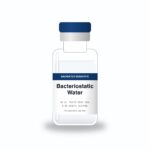
From BacWater Scientific
10 mL bacteriostatic water, stocked in the US
0.9% benzyl alcohol, multi-dose vials. The per-vial price drops automatically at 3, 5 and 10 vials.