No. On paper bacteriostatic water is two ingredients, water and 0.9% benzyl alcohol, which makes it look like something you could mix at home. In practice the ingredients are the easy part. What you cannot reproduce outside a controlled facility is sterility, freedom from pyrogens, an accurately verified preservative level and any way to confirm you achieved all three.
This question spikes whenever supply gets tight, so it deserves a real answer rather than a warning label. Below is what the manufacturing process actually involves, step by step, and where a home version fails at each one.
What bacteriostatic water has to be
The FDA label describes Bacteriostatic Water for Injection, USP as a “sterile, nonpyrogenic preparation of water for injection” containing “0.9% (9 mg/mL) of benzyl alcohol added as a bacteriostatic preservative.”
Unpack that and you get four separate requirements:
- Water for injection, a specific USP grade of highly purified water, not distilled or deionized water from a shop.
- Sterile, meaning free of living microorganisms.
- Nonpyrogenic, meaning free of fever-causing substances, principally bacterial endotoxins.
- 0.9% benzyl alcohol, an accurate, verified concentration. Not roughly. Verified.
A home process can attempt the first and the fourth. It cannot achieve the second and third with any confidence, and it cannot demonstrate any of them.
Where each home method breaks down
“I’ll boil the water first”
Boiling kills many microorganisms, so it addresses part of sterility. It does nothing about pyrogens. Bacterial endotoxins are fragments of the outer membrane of gram-negative bacteria, and they are heat-stable. You can kill every organism in a container of water and still be left with the endotoxins they leave behind. That is precisely why “sterile” and “nonpyrogenic” are listed as separate properties on the label.
“I’ll start with distilled water”
Distilled water is purified, not sterile. It is bottled in a non-sterile environment, it is not tested for endotoxins, and the container itself is not sterile. Purity and sterility are different properties, and distillation only addresses one of them.
“I’ll measure the benzyl alcohol carefully”
Getting to 0.9% means 9 mg of benzyl alcohol per millilitre of solution. Hitting that with kitchen measuring equipment is guesswork, and the consequences run both ways: too little and the preservative will not reliably inhibit growth, too much and you have changed the composition of the solution you are about to put your material into. Manufacturers confirm the final concentration analytically. At home there is nothing to confirm it with.
“I’ll filter it through a 0.22 micron syringe filter”
Sterile filtration is a genuine industrial technique, and it is the closest a home method gets. But it only works as part of a system: the filter must be verified as integral, everything downstream of it must be sterile, and the filling must happen in classified air. Push filtered water into a non-sterile container in a kitchen and you have recontaminated it on the way out. Filtration also does not reliably remove endotoxins, which are small enough to pass through.
“I’ll reuse a vial and refill it”
The stopper of a used vial has been punctured repeatedly and is no longer a reliable seal, and the interior is no longer sterile. Refilling it compounds every problem above.
What a real production run involves
To see the size of the gap, here is the sequence a manufacturer follows:
| Step | What it takes | Home equivalent |
|---|---|---|
| Produce water for injection | Multi-stage purification systems with continuous monitoring | None |
| Add preservative to 0.9% | Calibrated analytical balances, verified by assay | Kitchen measurement, unverified |
| Sterilize | Validated sterile filtration or terminal sterilization | Boiling, which leaves endotoxins |
| Fill and seal | Aseptic filling in classified cleanroom air, sterile vials and stoppers | Open room air, non-sterile containers |
| Test the batch | Sterility testing and bacterial endotoxin (LAL) testing | No test exists at home |
| Assign shelf life | Stability studies over time | Guess |
Every one of those steps exists because of a failure mode someone discovered the hard way. The last row matters more than people expect: without stability data you have no basis for an expiration date, so a home batch has an unknown shelf life from the moment it is made.
You cannot check your own work
The deepest problem is not any single step. It is verification. Contaminated water looks exactly like clean water. Endotoxin-laden water looks exactly like pyrogen-free water. A 0.6% preservative level looks exactly like 0.9%.
Manufacturers do not trust their eyes either, which is why sterility testing and endotoxin testing exist. Without access to those, a home batch is untested no matter how carefully it was made, and “it looked fine” is not evidence of anything.
What to do instead when you cannot get bac water
Supply genuinely does get tight. Bacteriostatic water for injection has appeared on US drug shortage lists, and the FDA drug shortage database is where to check its current status. If you are stuck, the realistic options are:
- Try a different supplier. Pharmacy stock, medical distributors and dedicated online suppliers rarely run dry at the same time. Our guide to where to buy bacteriostatic water compares every route.
- Use a single-use sterile alternative if your method allows it. Preservative-free sterile water works for a one-time preparation, with the remainder discarded. See bacteriostatic water vs sterile water.
- Wait. Shortages are usually temporary, and an unverified substitute is a poor trade against a few days of delay.
- Stock up once supply returns. Sealed vials keep until their printed expiration date, so a small backup supply costs nothing in waste. That is also the fix for why bac water is so often hard to find.
The regulatory side, briefly
Beyond practicality, this is a regulated product. Bacteriostatic Water for Injection, USP is an FDA-regulated drug with a National Drug Code, and preparing sterile drug products is governed by manufacturing and compounding rules such as USP <797>. Those standards exist for facilities and licensed compounders, not for home preparation.
The bottom line
The recipe for bacteriostatic water is trivial. The product is not the recipe. It is sterility you can demonstrate, an absence of pyrogens you can demonstrate, and a preservative level you can demonstrate, in a sealed container with a known shelf life. None of that is reproducible at home, and none of it can be checked afterward.
Next: read what bacteriostatic water is, or compare your buying options.
Frequently asked questions
Can you make bacteriostatic water at home?
No. Producing it requires sterile, pyrogen-free water for injection, a precisely measured 0.9% benzyl alcohol level, aseptic filling into sealed multiple-dose vials and laboratory testing to confirm sterility and endotoxin limits. None of those steps can be done in a home setting.
Can you just add benzyl alcohol to distilled water?
No. Distilled water from a store is purified but neither sterile nor pyrogen-free, and hand-measuring a 0.9% preservative level without analytical equipment is guesswork.
Does boiling water make it sterile enough?
Boiling can kill many microorganisms, but it does not remove bacterial endotoxins, which are heat-stable and are exactly what ‘nonpyrogenic’ refers to.
What is the difference between sterile and pyrogen-free?
Sterile means free of living microorganisms. Pyrogen-free means free of fever-causing substances such as bacterial endotoxins, which can remain after the organisms themselves are dead.
What should I use if bacteriostatic water is out of stock?
Buy from another supplier that states the volume and the 0.9% benzyl alcohol content, or use a single-use sterile alternative if your method allows it and discard the remainder.
Is it legal to make bacteriostatic water?
Bacteriostatic Water for Injection, USP is an FDA-regulated drug product. Producing sterile drug products is a regulated activity subject to manufacturing and compounding rules, which is a separate matter from whether it is practical.
Sources
- Bacteriostatic Water for Injection, USP prescribing label, DailyMed, U.S. National Library of Medicine dailymed.nlm.nih.gov
- USP General Chapter <797> Pharmaceutical Compounding: Sterile Preparations usp.org
- FDA Drug Shortages Database dps.fda.gov
We write from primary sources such as FDA drug labels and USP standards. See our editorial policy. Spot an error? Email [email protected].
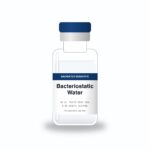
From BacWater Scientific
10 mL bacteriostatic water, stocked in the US
0.9% benzyl alcohol, multi-dose vials. The per-vial price drops automatically at 3, 5 and 10 vials.